

Boswellia serrata, El árbol del incienso indio, ha sido un pilar fundamental de la medicina ayurvédica durante más de tres mil años. Su resina —que se obtiene realizando incisiones en la corteza y dejando que el exudado se cristalice— contiene un grupo de compuestos triterpenoides llamados ácidos boswélicos, que se encuentran entre los agentes antiinflamatorios naturales más investigados en la fitoterapia moderna. Para cualquiera que padezca inflamación articular crónica, trastornos digestivos o inflamación respiratoria, merece realmente la pena comprender qué hace la Boswellia —y qué dicen realmente las pruebas científicas—. ¿Qué es la Boswellia serrata?
La Boswellia serrata es un árbol de tamaño mediano originario de las regiones montañosas y áridas de la India, Pakistán y el extremo occidental de la península arábiga. Pertenece a la familia Burseraceae, la misma familia que otros árboles productores de resina utilizados históricamente en las tradiciones de incienso en África y Oriente Medio. La resina que produce varía en color desde el dorado pálido hasta el ámbar intenso y se ha comercializado en todo el mundo antiguo durante milenios, valorada tanto por sus propiedades aromáticas en ceremonias religiosas como por sus aplicaciones medicinales. En el contexto de los suplementos modernos, no se utiliza la resina entera, sino extractos estandarizados concentrados por su contenido en ácidos boswélicos. Los productos de calidad suelen especificar qué porcentaje del extracto está compuesto por ácidos boswélicos —comúnmente entre el 65 % y el 70 %, o más—, lo que permite una dosificación constante que la resina en bruto no puede proporcionar.
Compuestos activos y sus mecanismos
La actividad terapéutica de la Boswellia serrata se atribuye principalmente a sus ácidos boswélicos, una familia de ácidos triterpénicos pentacíclicos. El más significativo desde el punto de vista farmacológico es el AKBA (ácido acetil-11-ceto-β-boswélico), que ha sido identificado como el inhibidor más potente de entre ellos.
Los ácidos boswélicos actúan a través de varios mecanismos antiinflamatorios distintos que difieren de manera importante de los de los fármacos antiinflamatorios no esteroideos convencionales (AINE):
- Inhibición de la 5-lipoxigenasa (5-LOX) — el mecanismo principal y mejor caracterizado. La 5-LOX es la enzima que convierte el ácido araquidónico en leucotrienos, una clase de mediadores inflamatorios implicados en afecciones inflamatorias crónicas, como el asma, la enfermedad de Crohn, y la artritis. Los AINE no inhiben esta vía; se trata de un mecanismo distinto y complementario.
- Inhibición de NF-κB — los ácidos boswélicos inhiben el factor nuclear kappa-B, una molécula reguladora central en la expresión génica inflamatoria, reduciendo la producción de citocinas proinflamatorias.
- Inhibición de la elastasa leucocitaria — reduce la actividad enzimática asociada a la degradación tisular en las articulaciones y vías respiratorias inflamadas.
- Modulación del sistema del complemento — algunos ácidos boswélicos interfieren en la activación del complemento, una rama del sistema inmunitario implicada en el daño tisular inflamatorio.
Este perfil mecánico —en particular la inhibición de la 5-LOX— significa que la Boswellia actúa sobre vías inflamatorias que no son abordadas por los AINE estándar, que en cambio se dirigen a las enzimas COX-1 y COX-2. Esto es clínicamente significativo: para las personas que no pueden tolerar el uso prolongado de AINE (debido a riesgos gastrointestinales, renales, o cardiovasculares), la Boswellia ofrece una vía alternativa sin los mismos efectos adversos.
Aplicaciones basadas en la evidencia
Salud articular: osteoartritis y artritis inflamatoria
Esta es el área de aplicación más ampliamente investigada. Múltiples ensayos controlados aleatorios han investigado el extracto de Boswellia serrata en la osteoartritis de rodilla, observando sistemáticamente reducciones en las puntuaciones de dolor, mejoras en la función física, y una reducción de la inflamación articular en comparación con el placebo. Un ensayo frecuentemente citado que comparaba la Boswellia con el valdecoxib (, un inhibidor de la COX-2), encontró que, si bien el fármaco producía un alivio más rápido, los efectos de la Boswellia eran más sostenidos una vez finalizado el periodo de tratamiento —una diferencia farmacodinámica interesante que podría reflejar su acción sobre la remodelación de las vías inflamatorias en lugar de simplemente enmascarar los síntomas agudos.
En la artritis reumatoide, la evidencia es menos extensa, pero en general respalda un efecto antiinflamatorio significativo. La boswellia no sustituye a los fármacos antirreumáticos modificadores de la enfermedad ((FAME)) utilizados en el tratamiento de la AR, pero puede ser un complemento útil.
Enfermedades inflamatorias intestinales
Los ácidos boswélicos reducen la producción de leucotrienos en la mucosa intestinal y tienen efectos antiproliferativos sobre las células inflamatorias intestinales. Los estudios clínicos en la enfermedad de Crohn han mostrado resultados comparables a los de la mesalazina (, un medicamento estándar a base de ácido 5-aminosalicílico), en el mantenimiento de la remisión. Los estudios sobre la colitis ulcerosa han mostrado reducciones en los índices de actividad de la enfermedad. Estos hallazgos posicionan a la Boswellia como una opción de apoyo complementario para quienes padecen enfermedades inflamatorias crónicas del intestino —no como un sustituto del tratamiento médico, sino como un producto botánico con una relevancia mecánica genuina para la inflamación intestinal.
Inflamación respiratoria y asma
La vía de los leucotrienos que inhibe la Boswellia está directamente implicada en la broncoconstricción y la inflamación de las vías respiratorias en el asma. Los ensayos clínicos han revelado que la suplementación con Boswellia redujo la frecuencia de los ataques de asma y mejoró los parámetros respiratorios en participantes con asma crónica de leve a moderada, con un número significativamente mayor de participantes en el grupo de tratamiento que mostraron mejoría en comparación con el placebo. Se trata de un ámbito en el que el mecanismo de la 5-LOX es especialmente relevante, ya que los leucotrienos cisteínicos son uno de los principales factores que provocan el estrechamiento de las vías respiratorias en el asma.
Investigación cerebral y neurológica
Investigaciones recientes sugieren que el AKBA podría atravesar la barrera hematoencefálica y se ha estudiado en el contexto de los tumores cerebrales (glioblastoma), donde podría reducir el edema y afectar potencialmente a la proliferación de las células tumorales. Se trata de un área en desarrollo que suscita un interés preliminar significativo en la comunidad investigadora, pero con una aplicación clínica limitada hasta la fecha. Merece atención a medida que la investigación madura, pero no debe sobrevalorarse en el panorama actual de la evidencia.
Cómo elegir un suplemento de Boswellia
La estandarización es el indicador de calidad más importante. Busque productos que indiquen el contenido de ácido boswélico como porcentaje del extracto; los productos estandarizados al 65-70 % o más de ácidos boswélicos proporcionan una dosis clínicamente significativa. El contenido de AKBA es un indicador de calidad adicional que se encuentra en algunos productos de gama alta.
La dosis en la mayoría de los estudios clínicos ha oscilado entre 300 y 500 mg de extracto estandarizado, de dos a tres veces al día. Algunos protocolos utilizan dosis más altas. Los componentes liposolubles de la resina se absorben mejor cuando se toman con alimentos que contengan algo de grasa. Una nota práctica importante: la mayoría de las investigaciones sugieren que los efectos de la Boswellia se desarrollan tras 4-8 semanas de uso constante; no es un analgésico de acción rápida como lo son los AINE, y los ensayos a corto plazo pueden subestimar sus beneficios.
Explore nuestra colección de productos para huesos, articulaciones y cartílagos, donde encontrará suplementos de Boswellia serrata y productos complementarios para la salud de las articulaciones:


Now Foods
Now Foods Extracto de Boswellia 500mg - 90 Cápsulas blandas
Precio normal €20.39Precio unitario€0.23 cada artículo
Swanson
Swanson Full Spectrum Boswellia 800 mg - 60 Cápsulas
Precio normal €6.69Precio unitario€0.11 cada artículo

 25 % de descuento
Vitaler's
Vitaler's Boswellia Serrata 200 mg - 60 Cápsulas
Precio de venta €5.39 Precio normal €7.19Precio unitario€0.09 cada artículo


Swanson
Swanson Espectro Completo Boswellia y Curcumina - 60 Cápsulas
Precio normal €5.59Precio unitario€0.09 cada artículo


Doctor Life
Doctor Life Cúrcuma, Jengibre y Boswellia - 60 Cápsulas Veg.
Precio normal €31.99Precio unitario€0.53 cada artículo


Combinaciones sinérgicas: Boswellia con otros fitoquímicos antiinflamatorios
La boswellia se formula con frecuencia junto con la curcumina (procedente de la cúrcuma) y el MSM ((metilsulfonilmetano)) en productos para la salud articular, y esta combinación es lógica: la curcumina inhibe las vías NF-κB y COX-2, mientras que la boswellia añade la inhibición de la 5-LOX, creando un enfoque complementario de múltiples vías para la inflamación articular. El MSM proporciona azufre biodisponible, necesario para la síntesis de colágeno y proteínas Glycan en el cartílago. En conjunto, estos compuestos abordan la inflamación articular y el soporte estructural desde múltiples ángulos. Nuestra colección de hierbas https://medpak.shop/collections/herbs"> incluye formulaciones independientes y combinadas:
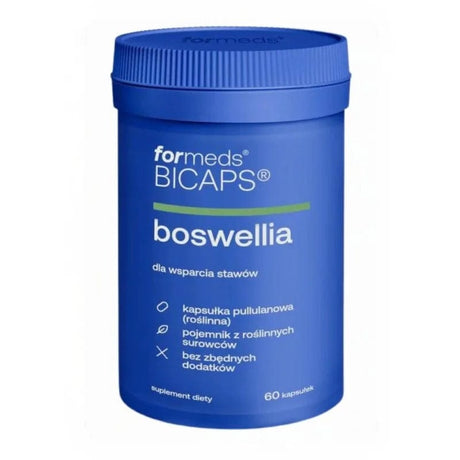
Formeds
Formeds Bicaps Boswellia - 60 Cápsulas
Precio normal €12.59Precio unitario€0.21 cada artículo 15 % de descuento
Yango
Yango Boswellia 65 440 mg - 90 cápsulas
Precio de venta €13.64 Precio normal €16.09Precio unitario€0.15 cada artículo


Now Foods
Now Foods MSM 1000 mg - 120 Cápsulas Vegetales
Precio normal €14.49Precio unitario€0.12 cada artículo


Swanson
Swanson Glucosamina, Condroitina & MSM - 120 Tabletas
Precio normal €14.39Precio unitario€0.12 cada artículo


Seguridad, Contraindicaciones, e interacciones farmacológicas
La Boswellia serrata se tolera bien en las dosis utilizadas en los estudios clínicos. Los efectos secundarios notificados son poco frecuentes y suelen ser leves: molestias gastrointestinales ocasionales (, náuseas, calambres estomacales, diarrea) y, en raras ocasiones, reacciones cutáneas. Estos efectos suelen estar asociados a dosis más altas y tienden a desaparecer al reducir la dosis.
Contraindicaciones y precauciones importantes:
- Embarazo y lactancia — el uso tradicional en contextos de inducción del parto hace que la Boswellia esté contraindicada durante el embarazo; no se ha establecido su seguridad durante la lactancia.
- Niños — datos de seguridad insuficientes para el uso pediátrico sin supervisión médica.
- Medicamentos inmunosupresores — la Boswellia modula las vías inmunitarias y puede interactuar con los inmunosupresores; es esencial el asesoramiento médico.
- Anticoagulantes — Interacción teórica con fármacos anticoagulantes (warfarina, aspirina, heparina); consulte con su médico.
- Enfermedades autoinmunes — los efectos inmunomoduladores justifican la precaución; consulte siempre a un médico.
- Afecciones renales y hepáticas — la seguridad del uso prolongado en dosis altas en estas poblaciones no está bien caracterizada; se recomienda supervisión médica.
Al igual que con todos los suplementos botánicos, es importante distinguir entre los usos de incienso y aromaterapia del incienso (, que implican la resina entera o su aceite esencial), y el uso medicinal como suplemento del extracto estandarizado de Boswellia serrata. Se trata de productos diferentes con aplicaciones distintas: la suplementación oral utiliza extractos hidrosolubles y liposolubles concentrados en ácidos boswélicos, mientras que los aceites esenciales no están destinados al uso interno.
Este artículo es solo informativo y no sustituye el consejo médico. Si tienes problemas de salud, estás embarazada, en periodo de lactancia o tomas medicamentos, consulta a un médico o farmacéutico. Los complementos alimenticios no sustituyen una dieta variada.


